tarot_scholar: A purple and gold loop against a glowing green background. (Light)
Just moving right along through the cards in order, we're now at how you'll be rewarded for your hard work and achievement. And, again, a card that I deliberately chose to represent that thing is its respective slot! Spooky!

The Ace of Swords )
tarot_scholar: A purple and gold loop against a glowing green background. (Light)
The next card in this mandala represents energies for the antidote to remove all barriers to prosperity and again it's fitting that the card in this spot is one that as an antidote—it's a card I chose as a solution to the problems I have with wealth and money (which were the 5 of Swords and the Ace of Pentacles).

The Empress )
tarot_scholar: A purple and gold loop against a glowing green background. (Light)
This is belated, because I'm a bad occult practitioner and didn't actually sit down and write my thoughts on these cards for the last few days. But hey, let's not let the perfect be the enemy of the good.

The next card I want to focus on is the Three of Cups—"the happiness and prosperity that you will manifest into reality."

Three of Cups )
tarot_scholar: A purple and gold loop against a glowing green background. (Light)
Wen suggests two full pages of reflections per day when contemplating this mandala. That seems like a tall order, but I'll do my best. Of course, when typing and posting a blog entry, it's hard to count pages. ;)

Day 2 )
tarot_scholar: A purple and gold loop against a glowing green background. (Light)
Just for shiggles, I worked through a modified version Mary K. Greer's "Prosperity Mandala" exercise (as per Benebell Wen). Some of it involves deliberately choosing cards and reflecting on them, and I had nice long hot takes on the cards I chose but then my DW client ate shit and lost the post. I won't rehash it—the process of writing it out helped me get through the exercise as I needed to do, and I don't think I had any singular insights worth sharing—but I will note the results here.

How the Universe will provide abundantly for your needs: The Chariot
Emotional and spiritual state that you'll be endowed with: The Four of Clubs
The happiness and prosperity that you will manifest into reality: The Three of Cups
Energies for the antidote to remove all barriers to your prosperity: The Empress
How you will be rewarded for your hard work and achievement: Ace of Swords
My personal revelation of prosperity: The 6 of Coins


It's worth noting here that there are two cards that are part of the meditative process that don't make it into this final mandala/spread. These are cards that represent your barriers to prosperity. One is a card that you deliberately choose (for me, the Five of Swords) and one is that you draw at random from the deck (The Ace of Pentacles). In my now-lost post, I noted that the 5 of Swords and the Ace of Pentacles represented the two extremes of an economic spectrum. Ruthless capitalism on one hand (5 of Swords) and my personal weird hangups about accepting favors and gifts and genuine generosity on the other (Ace of Pentacles).

It's noteworthy that the card I deliberately chose as how I want to be rewarded was the Ace of Swords, so its position here is encouraging.

And finally, while this s framed as a piece of Tarot money magic, I think it's clear from the cards I chose that I'm operating from a broader definition of "prosperity" than purely material wealth. But more on that in later journal reflections (the first one coming, hopefully, tonight!).
tarot_scholar: A purple and gold loop against a glowing green background. (Default)
It's been years since I first laid eyes on The Ghetto Tarot. I never quite forgot it, and then when someone in a holiday gift exchange group mentioned wanting to rehome her deck (no issue with it except the size), I jumped at the chance. Now it's mine!

When it arrived, I saw immediately what she meant by the size being an issue. These cards are much bigger than your standard Tarot deck:


Pictured against my Robin Wood deck, which is as standard as they come.

Riffle shuffling with this deck simply won't work for someone like me, with itty bitty baby hands. This deck requires my Klondike shuffling method.

And now for the interview!

What kind of readings are you best suited for? 3 of Cups

Social, relationship, and emotional issues. And just...social. I think this is a deck that wants to meet other people, so to speak. Reading for others as well as myself.


What kind of relationship do you want to have with me? 7 of Pentacles rx

Something about this card suggested frequent use to me—putting in effort, cultivating patience. Which would make sense with the 3 of Cups above!


What kind of readings do you hate? 10 of Brooms (Wands)

Melodrama; when I already know what the problem is and how to fix it; when it's something I've brought upon myself.


When do you work best? What kind of conditions/approach do you prefer? 2 of Brooms rx

With an open mind, without preconceived notions or plans—spontaneously.


Describe yourself in one card. 10 of Cups rx

Not an optimistic attitude, but not entirely a pessimistic one either. Realistic and pragmatic, though with dark humor—winking, sly. Blunt and without sugar coating, but loving.
tarot_scholar: A purple and gold loop against a glowing green background. (Default)
After spending all of my free time yesterday thinking about this, and doodling different grids, I've come to the following conclusion:

1. I had a small misunderstanding of temperament versus function pair. Sorting by function pair and sorting by temperament yields two different results. I'm including both here for my own reference.

2. There is a specific and esoteric gender madness to the court via a bunch of stories from the Golden Dawn about Holy Guardian Angels and reproduction and impreganation and regenerative cycles. The Kings/Knights and Knights/Princes are very definitely masculine in nature, but also represent an active element. The same theology holds that some elements are active/masculine and some are passive/feminine. If we take the courts as manifestations of energy, what happens if you have an active manifestation of passive energy, and vice versa? Is it tension or completion?

Who knows, but on the basis of that tension I've decided to express a rank as introverted; when they're sympatico, the rank expresses as extroverted. I've always had the sense that the Queens and Pages of the Cups and Pentacles were a little more extroverted and outgoing than their male counterparts.

Another way to think about it, if you want to reintroduce a hierarchy model to everything, is that if Kings represent mastery of their particular element, then their energy should be in tune with the element wrt activity/passivity.

Preliminary models then. )


A comparison of all three models looks something like this:

King of Wands
ESFP or ENFP
King of Cups
INFJ
King of Swords
ENTJ
King of Pentacles
ISTP, ISTJ, or ISFP
Queen of Wands
ISFP or INFP
Queen of Cups
ENFJ
Queen of Swords
INTJ
Queen of Pentacles
ESTP, ESFJ, ESFP
Knight of Wands
ESFJ, ESTP, ENTP
Knight of Cups
INFP or ISFJ
Knight of Swords
ENTP, ESTJ
Knight of Pentacles
ISTJ or ISTP
Page of Wands
ISFJ, ISTP, INTP
Page of Cups
ENFP or ESFJ
Page of Swords
INTP or ISTJ
Page of Pentacles
ESTJ or ESTP


I'm dumping this here so maybe I'll stop obsessing over it and give my brain a goddamn rest.
tarot_scholar: A purple and gold loop against a glowing green background. (Default)
I'm a big fan of Benebell Wen, generally speaking, but I'm a little too cynical (or socialist?) to entirely buy into "the 1% made it because they did the magical equivalent of working hard, turns out you just don't want it as much as they do!" line.

She and others are right to point out that economics, broadly speaking, functions a lot like magic: it's a weird amorphous thing that exists only because we will it to exist. More than five minutes of reflection on the concept makes that clear enough (see also: Sapiens, Sacred Economics). There are a lot of people who really, really, WANT to make a shit load of money, and who think about it all of the time, and are obsessed with it and are ready and willing to sacrifice anything they can to do so. Most of them stay poor, and not because they didn't want it enough.

Prosperity gospel is bullshit when organized religions preach it (do right in the eyes of the Lord and you'll be blessed financially!) and it's bullshit when esoteric hermetic practitioners preach it. The good news, at least, is that the occult is such a weird and disorganized bunch that we lack a 700 club exhorting viewers to send in money to get good with God. There are definitely unscrupulous practitioners, of course, but they lack an entrenched and efficient nation-wide machine for exploitation.

And even if we assume for a moment that each of these 1% billionaires actually for-real bootstrapped themselves into obscene wealth because they can't stop won't stop, I think it's fair to ask: why is this something to emulate? Hoarding all that wealth makes it instantly useless; money only has value when it's in circulation, facilitating transactions between people. A million dollars brings more value into human lives when it's spent on repairing roads, feeding the hungry, or purchasing art than when it's sitting in someone's bank account. That kind of magic isn't a blessing but a curse. The King Midas kind of curse, with a wide radius of collateral damage and where absolutely no one benefits and there's only suffering for everyone involved (remember, in the story his own daughter turns into gold as well; from her perspective, her father's obsession with wealth killed her).
tarot_scholar: A purple and gold loop against a glowing green background. (Default)
I've been thinking about the court cards again—I do that from time to time—and my latest inclination is: I really don't care for the traditional Golden Dawn/Crowley associations.

The larger (arranged?) marriage of Tarot and astrology is another point for later, but if you take for a moment that the two systems match in any meaningful way, the court cards are still a weird fucking mess.

In the GD methodology, each Minor Arcana card is a planet in a sign, right? 4 of Pentacles is Mars in Capricorn, 2 of Wands is Sun in Aries (or maybe that's 4 of Wands, it's late and I'm on a slow computer and I don't feel like checking).

This makes sense. If the Major Arcana are the big deal things, the archetypes and so on, and the Minor Arcana is how they manifest, then it's natural that the Major Arcana would be the ideal energies and Minor would be all of it in action.

This renders astrological assignments to the courts redundant, and also a poor fit: twelve signs for sixteen cards? There is a system, of course—for REASONS!!! the Princesses don't actually correspond to any of the signs, but honestly those reasons sound a lot like retconning to me. But let's assume that the reasoning there is sound: now, in addition to representation for all the zodiac signs in the Majors, you also have it in the courts.

Why do the signs get to double dip? Why does Cancer need the Queen of Cups and The Chariot?

Again, there is contradiction in the teachings: the court cards rule the last ten degrees of a sign and the first twenty of another. So the Queen of Cups rules over the last ten degrees of Gemini and the first twenty degrees of Cancer. But the court cards are also still associated primarily with ONE sign. Which is it, Crowley? One or two? I've heard the argument that this is to account for the court cards, representations of people as they are, to be complex and multi-faceted instead of a pure archetype. I call bullshit.

The other model of the courts is the multiplicity of elements: so all of the Pages/Princesses represent the earthy element of their particular element, the Knights/Princes air (or fire sometimes depending on who you're talking to), Queens water, and Kings fire (or air, depending again on who you're talking to). So then the King of Cups is the fiery aspect of water, and his character can be inferred (in part) from the interplay of those two elements. This is a more satisfying system for me, at least on the face, as it does have a Mandelbrot/fractal nature to it, because you can imagine that each subdivision has four further subdivisions, and on and on and on.

Theoretically this model could democratize the court cards, especially if you took away the ranking titles and just renamed everyone "Earth aspect of Air" or whatever. I say "theoretically" because within the Golden Dawn/Qabbalistic juggernaut clusterfuck the four Aristotlean elements have a rough ranking from least sacred to most. (Sacred is probably a poor choice of words here but you can read Crowley or GD/OTO commentary on your own time.) So earth is the lowliest, the least pure, and then fire is the highest and the pinnacle of creation (or whatever). Or ether, maybe. I forget what the official stance is on that. So a hierarchy of sorts remains, at least as long as you're cleaving to a GD-inspired take.

Moving away from Thoth- and GD-specific models of the courts you have what I assume are more modern takes: the courts representing the journey of learning the suits, from the novice Page to the master King; or the courts filling different roles within a kingdom of an element, or so on. One that I wonder might be fruitful is if you take them as manifestations of the different astrological sun/moon combinations viz a viz elements. So all the Cups are water Sun signs, and then the Page of cups would be an earth Moon sign, and so on. (Or reverse it! Depending on if you're practicing Western or Vedic astrology and whether you want to put emphasis on the Sun or the Moon.)

(Aside: age and the court is weird. I'm a proper fucking adult now and so are my peers, and while I've been able to identify with Queens since I started reading Tarot, the idea of thinking of my male peers as Kings is weird. Too weird. They're all knights; middle age is always ten years older than you.)

Also when I started reading Tarot, I thought that it was a happy coincidence that there were sixteen court cards and sixteen Nyers-Briggs types. Surely someone had mapped them, I thought! Nope. I thought up coming up with my own associations but never did (I'm not terribly fluent in MBTI speak, even now.) Googling now, a million years later, and someone has, but their system is weird and inconsistent. It seems only natural that cards should share traits according to element and rank, and yet they do neither.

What I still like about the MBTI as court cards is that it flattens the hierarchical structure, once and for all. If I were to create my own deck, I'd rename all of the court cards according to the MBTI archetypes. The Counselor, The Executive, The Mediator. A functioning society needs all kinds, and one kind isn't a more advanced or developed version of another. And the images would show them in that role, as well. The other thing I always hated about court cards is that, with apologies to Pixie and all of the artists she subsequently inspired, the figures are so flat and dull. (Or in the case of Thoth, they're such fantastical archetypes that they're impossible to read.) The reader is stuck inferring meaning from colors and symbols and whatever they know about the card's associations, rather than how we usually understand our fellow humans: interacting with either things or other people. But depicting someone in the role of a counselor, an entrepreneur, or a logician (lol okay not all the names are great)—that makes something click.

My own system, after a bit of thought, is this:

The Pages and Knights, insofar as they're focused on being curious and inquisitive and gathering data from the world around them, are perceiving types. The Queens and Kings represent the application of the data, and hence are judging types.

Pages and Queens are more receptive, making them introverts. The go-getting Knights and the authority figure Kings are inherently more extroverted.

The elements thus determine the functional pair of a given card: the middle two letters. Based on this rundown, I would argue that:

Pentacles: ST
Wands: SF
Cups: NF
Swords: NT

So then you end with the Queen of Cups as INFJ: the counselor, or the confidante. And the King of Cups then becomes ENFJ, the ideologist or the mentor. Granted, there aren't official archetype names for each type, so there's wiggle room. But you get the picture.

I could see the argument for saying that Wands and Swords would be extroverted while Pentacles and Cups would be introverted (better application of masculine/feminine energies?), in another system. And making temperament a function of rank rather than element. There are a couple different possibilities. But I like them all better than the current mishmash of astrology and Tarot that currently reigns (if you'll pardon the pun).
tarot_scholar: A purple and gold loop against a glowing green background. (Default)
In my early 20s, I went through a phase of compulsive Tarot deck collecting. I didn't pick up every Tarot deck I came across, but I was always looking for more and had very little self control when it came to a deck I liked. For a broke college student, my collection was a little out of control.

The pendulum swung the other way a few years later. I stopped compulsively acquiring decks and gave away a couple that no longer held my interest (or that never had). I reevaluated my wishlist on Aeclectic Tarot (RIP the forums) and found that most of them no longer held my interest, or at least not enough of it to justify buying more stuff.

This dry spell went on for years. A couple of times I ran across a deck with a neat concept, but it was never enough to get me to open my wallet. Until Baba Studios' Victorian Romantic Tarot. Something about the art absolutely fascinated me, and I found myself browsing images of the deck online when I had nothing better to do.

"The thing about being an adult," I realized, "is that if I want something nice, I can just buy it."

And so I did.

Today it's one of my favorite decks, but I always felt like there was more going on than what the deck's LWB was getting at. I knew there was a companion book, but it was out of print for a long time. Magic Realist press has finally put out a new edition (to match the third edition of the deck), which I had preordered as soon as they announced it.

Barbara Moore is the queen of companion books, it feels like, but I generally dislike the ones she writes. Nothing personalm—Moore is a heavy hitter in the Tarot community and she knows her stuff—I just like companion books to be written by the artist(s) themselves, so you can get all the dirt. Karen Mahony is half of the artistic vision behind The Victorian Romantic Tarot, so I was excited to get the scoop straight from the horse's mouth, so to speak.

The physical quality of the book is a little disappointing. It feels flimsy, and the pages are extremely glossy, almost like a magazine. I imagine this has something to do with printing technology and the full-color pictures of the cards they opted to use, and to that end it's a worthy sacrifice to make. It still feels a little weird to the touch. On the very cool plus side, my pre-ordered edition came signed!

Mahony opens with a brief history of how the deck came to be, as well as a short primer on Victorian art: its recurring motifs and themes, the social norms reflected in it. As is standard with any book on Tarot, she then continues with a brief history, some tips for learning how to read, and spread suggestions. I skimmed over these sections to get to the meat of things; namely, the exegeses on their particular interpretation of the cards themselves.

Mahony provides keywords for the cards upright as well as reversed, and then devotes a page (sometimes two) to her thoughts on the card in general and the connection between her understanding of the card and how it's portrayed in this deck. If there were changes to a card between editions, she also includes what those changes were and why they were made. At the end of each short essay, she also includes (when possible) a biography of the original artist of a particular painting or engraving, as well as a (black and white) reproduction. Alas, sometimes the artist is unknown, or so obscure that only their name remains. (Many of the images were sourced from commercial products like magazines or postcards, where artist attribution wasn't particularly important.)

This is exactly the kind of stuff I want to see in a LWB, but then if you tried to cram all of this in a LWB it wouldn't be so little anymore! The keywords for reversals in particular will probably be incredibly helpful for many readers; in every card there was always a point or two Mahony raises in the reversal keywords that made me go, "Oh, now there's an interesting perspective, but that makes a lot of sense." Quite frankly, I don't understand why they aren't included in the LWB (at least, not in the second edition, which is the one I own).

What this companion book highlights in particular is the feminist (or at least woman-centered) framework that Mahony and Ukolov were working in when constructing the deck. By Mahony's own admission, the source material they were working with "was often highly sensual and even, at times, salacious...and depicted women as objects rather than people." Faced with this, Mahony and Ukolov decided "to include several beautiful images of lightly-dressed women, nymphs, fairies, and mermaids, but avoid any whom we felt looked victimised...[and] to use several pictures of confident, independent women." This feminist theme recurs in Mahony's discussion of particular cards as well (for example, in the original version of The Devil used in the first and second editions of the deck).

The Victorian theme is also prevalent throughout the work. Beyond simply taking beautiful art to make a gorgeous Tarot deck, Mahony and Ukolov clearly brought some of the Victorian context into the meaning and thinking about the cards: circuses, fallen women, funeral customs, that sort of thing. All of that provides a deeper level of meaning when reading with this particular deck. This is a companion book that also enriches your understanding of the classic Waite-Smith deck: the art and the social norms highlighted in this deck would have no doubt influenced Waite and Colman-Smith, whether directly or indirectly. Flipping through the deck, it's fun to imagine which images may have caught Pixie's eye back in the day and worked their way, however subdued or altered, into the Waite-Smith deck we all know and love today!

Overall, I consider this companion book an essential part of the deck itself, up there with The Russian Tarot of St. Petersburg's companion book. This goes double for any Tarot beginner who's chosen this gorgeous deck as their first (or one of their firsts); the introduction is full of good advice for developing your Tarot practice and a good, basic history of the occult usage of the cards. I'll be sure to keep this close by whenever I'm reading with the Victorian Romantic Tarot.

Book alert

Mar. 12th, 2018 10:10 pm
tarot_scholar: A black mystical-looking sigil on a white background. (Sigil)
Allow me to blow the dust off this little journal of mine and let y'all know that someone has started a series of novels (?) about Pamela Colman-Smith. I don't know if they're any good, either research-wise or writing-wise, but hope springs eternal...!
tarot_scholar: A black mystical-looking sigil on a white background. (Sigil)
Hello, I'm back after an extended absence of work and traveling. Is everyone okay, more or less? I have been a garbage LJ/DW friend for most of August, and I can only apologize. Back for real soon; for now I'm dropping in quickly with a book review.

I received a free ARC of Michelle Tea's Modern Tarot from a friend who works at a bookstore. They get ARCs and uncorrected proofs of things on a fairly regular basis, apparently, and the employees are allowed to help themselves. She picked this one up for me because it seemed relevant to my interests. I thanked her and added it to my TBR pile. A couple of weeks later, the author had an interview on the Biddy Tarot podcast. The interview prompted me to move Modern Tarot ahead in my reading schedule, and I actually finished it around the end of July. I've just been caught up with other stuff and haven't gotten around to talking about it until now. My review is also going to be pretty brief:

There is a value, I think, in the spell and ritual ideas that Tea offers to go along with each card. I intend to go through those portions of the book at a later date and take notes on the ones I feel are most relevant for me in my life/practice/whatever. (Also, a handful of the "spells" are actual for-real recipes that sound freaking tasty!) It's a fun angle that many Tarot books don't take. At best they opt for ~meditations~ which I kind of really, seriously hate (possibly because I have no imagination).

Everything else is sort of...meh. Tea gives the story of her picking up Tarot in the introduction and then the rest of the book, aside from the spells, is your standard guide to the cards. It's certainly a solid book for beginners but if you're well-read in Tarot lore there won't be too much that's new in here. I flip-flop on the historical context in which Tarot should be presented (how much should any given Tarot book talk about A. E. Waite or the Golden Dawn or alchemy?) and so my feelings on a book more or less taking the meanings out of a vacuum and running with them range from neutral to grumpy, depending on the day. It's the kind of book I'm going to hold on to because I suspect someone I know is going to want or need a book like this. (Is that someone you? It might be. Comment or PM me if you want it!)
tarot_scholar: A purple and gold loop against a glowing green background. (Default)
One of my favorite Tarot/metaphysical bloggers is Benebell Wen. (I think my Christmas present to myself this year will be a copy of her Holistic Tarot.) I very much appreciate how she weaves Western metaphysical concepts and occult traditions with Buddhist and Taoist ones—from a deep understanding of all three traditions. As a lapsed and/or lazy Buddhist who has also been very intrigued by Taoism, you can see how this is very much My Thing. Anyway, my point is that Wen has this to contribute when it comes to the magical resistance:

For those who want to be the sideline cheerleaders supporting our witchy friends on their magical social justice endeavors, if this feels better, you can follow in the footsteps of Buddhist monks on their forms of peaceful resistance and protest against totalitarian regimes. This was done in Burma and Tibet.

Send strengthening metta energies to give a boost to those working the binding and those working actively in the mundane world to counteract POTUS #45. Do so by reciting as a mantra passages from the Metta Sutta, specifically as follows (in Pali):

Sukhino vā khemino hontu
Sabbe sattā bhavantu sukhi-tattā

English translation:
May all beings be well and safe;
may their hearts rejoice.

I know, the English translation makes the mantra sound not perfectly relevant, but it’s craft and it’s used in esoteric Buddhism (and Taoism), and in the context of that craft, is relevant energy-wise. You’re connecting your personal energies and strength with the Divine or higher consciousness and then directing it outward to amplify the power of those who are in a tangible position to make a difference.


You can find a recording of the entire Metta Sutta here: https://www.youtube.com/watch?v=bRIaO-XCy-k

I've also been taken by Hecate Demeter's "Magical Battle for America" workings. In the comments there is a recording of the working, guided meditation style. I'm working on cleaning it up and also adding some sound/musical cues; I'll share that here when I finish it.
tarot_scholar: A purple and gold loop against a glowing green background. (Default)
I've complained about the Celtic Cross spread before. And I still hate it! In addition to a "general reading" spread of my own creation (details at the link), I like using the standard astrological houses spread for all-purpose readings, including ones for myself at the solstices and equinoxes. I'm fairly familiar with astrology, and much as I'm not really super into the brand of occultism favored by the Golden Dawn or Crowley et al. (it's a little Christo-pagan for my liking), I recognize that Tarot as the divination tool it is today owes a lot to them, so there are concessions I'm willing to make, and the astrological associations are one of them. I find it to be the best paradigm for the Thoth deck in particular, since it makes no secret of putting the astrology right there in the image for you. Not only that, but astrologically themed readings are by nature complex and systematic, and I can't think of two better words to describe the Thoth deck than "complex" and "systematic."

I should note that within its full context, an astrological spread like this would actually constitute the "third operation," and would only be performed if the first two were successful. But more on that in another post. I have become quite taken with the first two operations myself, but frankly I don't think you need them if you have your own method going, so I'll touch on them later.

Sometimes my understanding of the houses in the context of astrology doesn't always translate to a good intuitive feel for what they would be in a divinatory context, though, so this entry is as much an attempt to share knowledge as it is to nail it down, hah.

Before I dive in, here is some background information on the houses (in the context of natal charts).

Anyway, a finalized version of how I use the houses in a Tarot reading.

The First House

First and foremost, I see this as a summary of the upcoming period in question, or as a significator for the querent (depending on if you're reading about the future or "right now"). If it's a card associated with a particular sign, whether Major Arcana, Minor Arcana, or court card, it sets the the ascendant for the rest of the reading. This is actually really important, because this will determine which cards are well-dignified and which ones are ill-dignified.

For example, let's say that the card that turns up in the first house is The Chariot. This card is associated with Cancer, and thus puts Cancer on the ascendant. The next house will be ruled by Leo, and then Virgo, and so on.

If the card isn't associated with a specific zodiac sign as per the Golden Dawn (so: the Princesses, the Aces, and the elemental/planetary Major Arcana), the natural rulers of the houses are used throughout the spread. In a nutshell, this is how you figure out which cards are reversed (more or less) in the Thoth deck. How I do it, anyway. ;)

It occurs to me after writing all of this up that an alternative method of house distribution in a spread might be continuing until you hit the first zodiacal card in the spread. So if you have The High Priestess, the Ace of Swords, and then the 3 of Wands, you would start with Aries in the third house (3 of Wands being associated with Sun in Aries), which translates to Aquarius in the first house. Or maybe you would check the the angular houses first, than the succeedent, then the cadent. (Angular succeedent cadent whaaat?)

But more on this in another post!

On a less esoteric level, the first house in a Tarot spread represents:

your personality
your approach to the world
the persona you want to project
your body (materially, e.g. injuries or accidents; health overall comes later)

Paul Foster Case's method also includes "[your] own initiative and action" in this category. The natural ruler of the first house is Aries.

The Second House

The second house is about wealth. Specifically: how you earn it. What talents do you have? It's also a house about values: what do you value in yourself? in others?

The natural ruler of the second house is Taurus.

The Third House


The third house is about cognition. It's about knowledge -- the ability to grasp facts, and remember and understand them -- and it's about the world immediately around you. It's about short trips, writing, communication, and siblings. Neighbors also fall into this category, as does basic schooling.

The natural ruler of the third house is Gemini.


The Fourth House


The fourth house is all about family. From siblings in the third house, we're now moving back into ancestors. This is the house that rules the cozy, home-y parent (or the cozy, home-y side of both parents). Traditional gender roles ascribe this to mothers, but it's a new world and gender roles are bullshit. This is the house of the "good cop" in the "good cop/bad cop" parenting dynamic.

Beyond that, it's also the house of real estate, land and property, and everything else about roots.

The natural ruler of the fourth house is Cancer.


The Fifth House


The fifth house is fun. Love affairs, gambling, the arts, children, all that good stuff. This is all about creativity and expressing yourself.

The natural ruler of the fifth house is Leo.


The Sixth House

The sixth house is about work and maintenance and duty. What do you do to keep things going? What does your everyday life look like? This is also the house of health issues (not surprise accidents or injuries, but whatever ongoing problems that you need to take care of).

Case also notes "relations with superior and inferiors."

The natural ruler of the sixth house is Virgo.


The Seventh House

This is about partnerships, unofficial and official (but especially official). It's the house of marriage, contracts, open enemies, negotiations, and court cases.

The natural ruler of the seventh house is Libra.


The Eighth House

One of the two ~scary~ houses in astrology (the other being the twelfth house) because of its historical association with death and matters connected to it (inheritances, spirits, etc.). Good times! The other Big Two in the eighth house (besides death) are taxes and sex. The occult is also part of this house.

In Case's tradition (specifically within his sequence of operations), this house is some bad ju-ju (unless you're inquiring about a spiritual or occult matter). Its reputation is a bit softer today, and we generally refer to it euphemistically as a house of transformations. Its natural ruler is Scorpio.


The Ninth House

The keyword for this house is "broadening horizons." It's related to higher learning (university as opposed to primary school), philosophy, religion, long journeys, and the law. To frame it within the context of the old joke, the third house is about knowing that the tomato is a fruit; the tenth house is about not putting it in fruit salad.

Its natural ruler is Sagittarius.


The Tenth House

This is the house of persona and career. What's your role in society at large? How does the public perceive you? It's also associated with the "bad cop" parent (traditionally the father, but again: gender roles are for chumps) and authority in general: governments, bosses, etc.

Its natural ruler is Capricorn.


The Eleventh House

This is the house of friendship and ideals. Government is the purview of the tenth house; the eleventh is about aspirational political groups. Case also notes "hopes and fears; finances of the employer."

Its natural ruler is Aquarius.


The Twelfth House

The other ~scary~ house of the zodiac, the twelfth house rules the subconscious and the unconscious. It's the house of hidden enemies and blind spots, and it's also the house of anything that takes us out of waking, ordinary life: prisons, hospitals, substance abuse. Case also notes secret societies associated with this house.

Its natural ruler is Pisces.

For example: )

I'll leave out an interpretation there, because this is already getting long for what I wanted. But you can see at least how elemental dignities would provide important context for each card. You can also see why I think a spread like this gives a better snapshot of a person's overall life situation than the standard Celtic Cross.
tarot_scholar: A purple and gold loop against a glowing green background. (Default)
A post from the official Bind Trump Facebook group, quoted in its entirety:

Just a thought... I make it a point to keep the First Family out of my political views...but I believe as pagans we need to discuss this. The First Ladies' spokesperson responded to the Trump tweet degrading yet another powerful woman about her intellect and appearance, by saying in short, "When my husband feels like he is being attacked, he punches back ten times harder". My first thought was, "sounds like an opinion informed by personal experience", AND "she had it coming". Both are clear signs of dominance, if not abuse.
Our practice not only ritualizes the balance between the male and female, but celebrates it. I am reminded of the Brehon laws of ancient Celtic Culture. Women were equal. Period. In wealth, status, the family, the community and in sexual relationships. A Celtic woman did not depend upon, or defer to a man. She was an equal entity entitled to the same protection under the law. There was no need for a "prenuptial agreement". Celtic (pagan) women were entitled to everything they brought to a relationship, and one half of everything produced during that relationship. Thanks to Rome for killing that.

As pagans we innately respect and protect the perfect balance and symbiotic relationship between the sexes. We cannot practice if we do not draw upon each other's strengths and support one another in weakness. The masculine and feminine are not opposed to one another, they are dependent upon each other.

As a community we must encourage one another (which we do), but as individuals we must stand firm in speaking out against those who would divide us based upon our gender. It was inappropriate in the Middle Ages, and it is inappropriate now.

Yes, this is a rant. I am ranting because someone tried to make me feel bad about myself because I am a girl. I am ranting because someone implied that a powerful woman is a threat. Powerful women are necessary to promote healthy relationships, families, communities, governments and social justice. As brothers and sisters, we need to vocally and magically reject opinions which would degrade any of us.
Please remember this as we prepare for the next binding. We need to put an appropriate emotion behind our works to add the magical "oomph" needed to materialize our intention. Frustration is a synonym for helplessness. Righteous indignation is a stronger emotion than frustration. Anger is a more positive emotion than frustration. Use them well.


Except no. Even the most cursory visit to Wikipedia (see: Ancient Celtic women) will tell you otherwise. The short version is:

The position of ancient Celtic women in their society cannot be surely determined due to the quality of the sources. On the one hand, great female Celts are known from mythology and history, on the other hand, their real status in the male-dominated Celtic tribal society was socially and legally constrained. Yet Celtic women were somewhat better placed in inheritance and marriage law than their Greek and Roman contemporaries. The situation of Celtic women on the European mainland is almost entirely transmitted by contemporary Greek and Roman authors, who saw the Celts as barbarians and wrote about them accordingly. Information about Celtic women of the British Isles comes from ancient travel and war narratives, and possibly the orally transmitted myths later reflected in Celtic literature of the Christian era. Written accounts and collections of these myths are only known from the early Middle Ages. Archaeology has revealed something of the Celtic woman through artefacts (particularly grave goods), which can provide clues about their position in society and material culture. Reliefs and sculptures of Celtic women are mainly known from the Gallo-Roman culture. A consistent matriarchy, which was attributed to Celtic women by Romantic authors of the 18th and 19th centuries and by 20th century feminist authors, is not attested in reliable sources.


Christianity did not bring patriarchy wherever it went. It might have exacerbated it, sure, but if there was any kind of real-life gender equality utopia anywhere in ancient Europe, they left no trace. It's probably unlikely, though—this is a kind of fall out of Paradise that's up there with Eden and the snake it terms of truth factor.
tarot_scholar: A purple and gold loop against a glowing green background. (Default)

This is a Prayer to Ama-no-Uzeme, Baubo, and Silly Old Aunts. This is a Prayer for Resistance.

sheela


This is a prayer to Ama-no-Uzeme. This is a prayer for Resistance.

This is a prayer to her sister, Baubo. This is a prayer for Resistance.

This is a prayer for the old women who dance naked to make us laugh. This is a prayer for Resistance.

This is a prayer for jokes about drinking, jokes about chin hair, jokes about gas. Old women make up the Resistance.

This is a prayer for laughing at yourself, taking no one too seriously, being self-aware. Old women make up the Resistance.

This is a prayer for the tricksters, a prayer to old broads, a chant about tennis shoes and walkers. Old women make up the Resistance.

When the Moon is full, I call to them.

I bring wine to make them bawdy. I bring mirrors to hang upon trees. I bring a long history of getting over yourself.

I bring breasts that droop, Shelia Na Gig t-shirts, and gin (old women always drink gin).

“Come, Ancient Tricksters,” I say. “Come dance and make our laughter turn into freedom.”

They come as they have always come. Laughing among themselves at some old secret. Carrying casseroles, wearing shawls, with purses that hold Cherries in the Snow lipsticks, worn down, half-full, years old.

They come as they have always come. Singing old songs only they remember. Tickling babies and pinching cheeks, exclaiming in awe over the miracle of children growing taller.

They come as they have always come. In sweaters, even in June. A box of rugelach, divinity in a metal tin, a cardboard box that looks like the car in a circus train, filled with animal crackers. Soup.

“Grandma!” I cry. “Aunt Ester!” “Great Goddesses of mirth! We can’t laugh when our democracy is failing. We can’t be happy when injustice has won. We want to hide.”

“Old Ones,” I cry. “You who drool and wheeze! Forget Vaudeville, forget stand-up, forget old knock-knock jokes! All is in ruins and we are bereft. No jokes can save us; we want to retreat from this fight!”

They poke us in the ribs, Ama-no-Uzeme, Baubo, and Shelia Na Gig. They pinch our cheeks and tickle us under our chins. They tell us to eat, get some rest, go for a walk.

They whip off their jogging suits. Drop their house dresses. Stomp on their own dignity.

“What would you do if you weren’t afraid to look silly?” they challenge us. “The only way I can teach you how to fight is to slip this lesson in between your pride and your fear,” they tell us. “How would you do this if it were the last thing you would do?” they insist upon asking. “Strip away all your pretense. Do the one thing that needs to be done. Never be afraid again.”

Listen.

This is a prayer to foolish old women. Old women make up the Resistance. This is a prayer to Ama-no-Uzeme, Baubo, and Silly Old Aunts. This is a prayer for Resistance.
tarot_scholar: A purple and gold loop against a glowing green background. (Default)
[personal profile] jenny_evergreen's first monthly card draw for me was in regards to prior thoughts on the nature of deity. So I put a question to the birds: "What do I need to know about my relationship to deity?" Since I brought up both her Patreon and Hekate here, I guess it's fitting I should follow up with a post that combines both of those topics.

The card that came up for me was blue jay:

Cyanocitta-cristata-004

Relevant bit of a slightly longer description: This bird is the cheerful, flexible opportunist...[and]...[h]e is a shameless thief (doesn't recognize the ownership concept, except for territory).

This is the part I keep coming back to. Maybe [personal profile] jenny_evergreen too, I can't know what her thought process is. She pointed out some options:

1. Trickery afoot (in which case either myself or Arwen or both are being hoodwinked)
2. A kind of deity being recommended (in this case, trickster)
3. I "should be emulating Bluejay, especially the 'cheerful, flexible opportunist' approach. So maybe this is not so much about making a lifelong bond with a deity, but letting them come and go..."

I list these in order of likelihood.

1. My instinct when it comes to both this particular deck and to [personal profile] jenny_evergreen's singular instincts is that a warning against trickery would be much stronger, and be much less oblique. And since I'm not paying anyone money, time, or energy for the privilege of having a relationship with a deity, I don't need someone to tell me not to get tricked. :P (Related to deception and manipulation, though, this dude is getting major side-eye in a Facebook group I'm in.)

2. More or less equally unlikely is a trickster deity. Sometimes we're repulsed by things because we secretly admire them, or wish we could be them; sometimes we don't click with something because that's just not our bag. And that's how I feel about trickster deities, by and large. A mode of being I can roll with out of necessity (think an actor putting on a "show" to help Jews escape an increasingly dangerous Germany, a la Mel Brooks' To Be Or Not To Be) but not for the lulz (think 4chan).

3. Now we're in the realm of the very likely, and [personal profile] jenny_evergreen admits as much herself, saying her instinct tilts towards this one as well. There are three aspects of this idea for me and they're all kind of related to this point. The first is the one that she speaks about directly: allow energies to come and go as they will. This is about not taking things super seriously—relationship with deity can and should fluctuate as necessary—but the second point is also being allowed to take something seriously if I want to.

The third, if I can build on this card and bring my own past to bear, is that it's okay to pick and choose. Not universally, necessarily. Definitely not, actually. But for me personally—I err on the side of the very careful and very fastidious (when it comes to the spiritual, anyway) and feeling like everything always needs to be the roots, the original, the purest form of whatever... so it's okay to relax, and it's okay to mix and remix and take what works for me and disregard the rest.
tarot_scholar: A purple and gold loop against a glowing green background. (Default)
Long-time LJ/DW friend [personal profile] jenny_evergreen/[personal profile] wrenstarling has started an oracle Patreon, and I would absolutely recommend giving it a look!

What makes this stand out from other divination Patreons is that she uses a deck of her own creation, featuring birds. I know birds are special to a few people I follow here, and I can tell you right now that this is an immaculately and thoroughly researched deck. (That's just the kind of person [personal profile] jenny_evergreen is.)

If you're unfamiliar with the Patreon model, the idea is that you can make a recurring monthly payment to, well, just about anyone: artists, writers, even some small businesses, in return for small (to large) goods or services. With [personal profile] jenny_evergreen, that means at least one monthly reading from an experienced reader using her own personal deck rich in meaning.

A quick snapshot of a spread in action:


Even though I'm comfortable with Tarot and often read for myself, sometimes you need someone outside of your own head to provide input and guidance; in the readings I've had from [personal profile] jenny_evergreen, she's been dead-on. She reads with intuition paired with healthy skepticism and rationalism, which is something I very much appreciate in occultism and the esoteric.

The minimum pledge ($1 / month) grants you access to the monthly single-card draws for the entire group; increasing pledges correspond to spreads of increasing personalization and complexity. Or you can be a rockstar just by sharing this Patreon with people you know who would be interested in it.

Thanks much!
tarot_scholar: A purple and gold loop against a glowing green background. (Default)
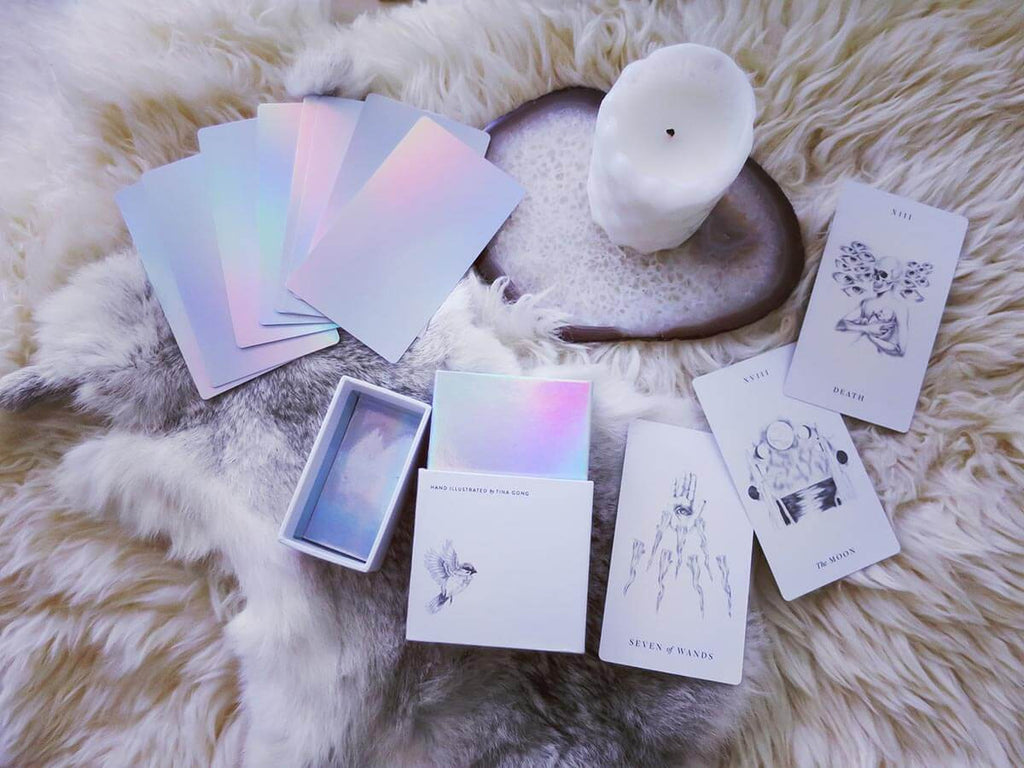
I've come across a couple of Tarot apps that I think are worth having. They're both the work of Tina Gong, in terms of code as well as art. Multifaceted!

I had been looking for a Tarot deck app for a while before I stumbled across her apps. I just wanted something quick and clean that could generate cards on the fly, which turned out to be a more challenging task than you might think. I had another one before, but it was gummed up with ads and was just a mess. (I don't remember which one it was, but even if I did, I don't think it's generous to badmouth a free app that was only mediocre.) For a while, I was using a random number generator. Golden Thread and Luminous Spirit Tarot are both what I wanted, plus more. (In a good way, not in an OPTIONS OVERLOAD way.)

Golden Thread is targeted at beginners. You can draw a daily card, and there are also spreads: one-card, three-card, and Celtic Cross. The single-card reading was perfect for my "I just need to draw a random card on the go" needs, and I'll be using it for that for the foreseeable future. It also helps you track a lot of neat Tarot data about yourself: how positive/negative your readings have been over time, the most common card keyword that's come up, etc.

The Luminous Spirit app is more intermediate focused and assumes you already have a solid working knowledge of the Tarot (though keywords are always available for each card, plus its reversal). Instead, it connects your readings to lunar cycles. You set an intention for each cycle, and then at each new phase of the moon, there's a different reading.

Each app uses a Tarot deck that has a physical, printed equivalent (hence my use of the "deck lust" tag here). The apps are free, and are free of ads. It's the sale of the physical items that helps support the apps. (And Gong's enthusiasm, natch.) I don't know how much I like the aesthetic of the Golden Thread deck, but I might very well pick up the physical Luminous Spirit deck:


This is a really well designed app, and I appreciate that they use original decks instead of just using the Waite–Smith deck. I admit that it wasn't until I did some research into Pamela Colman-Smith that I really appreciated the Waite–Smith deck, but now I'm totally onboard with it. My beef with Tarot apps using the Waite–Smith deck is more how it usually indicates a sort of lack of effort—just grab a public domain Tarot deck with easy-to-read images and go! No original decks, no recent decks that would mean paying licensing fees to artists or estates. (Of course, not every app or software with a more unique, modern deck is necessarily paying its artists. I recall a sketchy app ripping off a deck from the Magical Realist press.) But it's that extra attention to detail that makes an app really stand out, and that's why I think I'll continue to use it for a long time to come.
tarot_scholar: A purple and gold loop against a glowing green background. (Default)
Fellow Tarot nerd and high school classmate [personal profile] starfrosting Kickstarted his own deck last year, and I was amped to get in on the ground floor. How often do you get to work with a deck whose creator you actually know? (Okay, maybe some of you get to do this all the time, but I don't.) Before I get to pictures and my own thoughts, I'll let [personal profile] starfrosting introduce the deck in his own words:

The HIDDEN LIGHT Tarot is an elemental, fey, Jewitchy, & subtly spellbinding Tarot deck.

The HIDDEN LIGHT embodies my approach to Tarot honed over 15 years: elemental, imaginative, and viscerally magical. Created through collage and my multi-media pen, ink, and paint work, the cards themselves enact the divinatory process of Tarot— taking what's there to assemble and discern rich meaning. My half-a-lifetime experience as both zinester and Tarot reader yields a deck whose zine-witch aesthetic hums with raw, lively, fey power. The cards resonate with rich, subtle magic.

The HIDDEN LIGHT Tarot draws from traditional decks in its structure but sheds their hierarchical and patriarchal inheritances in favor of queer and immanent perspectives. In keeping with my own magical and Jewish practice, the spiritual themes of the cards are articulated in earthy, cosmic imagery that conjures wider tides of contraction, expansion, concealment, and revelation.

This deck is a tool for intimate conversation with the seen and unseen dimensions of life: for divination, meditation, and magic.
First, the physicality of the deck itself: It's a self-published indie deck, but the quality overall is stunning. The colors absolutely pop and the lines are clear and sharp. The borders are only a couple of millimeters, so the vast majority of card real estate is taken up with imagery. I have no preference when it comes to matte versus glossy finishes, but if you do, this is a matte deck. I found that traditional riffle shuffling was a little tough going at first (maybe the cards were too stiff?) but after a few rounds it's much smoother. Otherwise this deck is a candidate for my Klondike shuffling method, to avoid bunching near the top of the deck. The backs, while not perfectly reversible, are an abstract image of what I assume are stars against a night sky, so reversed cards are not immediately apparent face-down.

The images themselves have a raw and modern feel to them, particularly the Major Arcana. A couple have been renamed ("The Devil" becoming "Bondage" and "Judgment" becoming "Redemption," with the resulting changes in imagery), and the vast majority have what most people would term "non-standard" imagery. (Much of this depends on your own definition of "standard," of course.) For me, the Major Arcana is where this deck really shines. I would like to specifically point to [personal profile] starfrosting's interpretation of The Hierophant and The Emperor, cards I generally viscerally dislike. I vibe much more with this imagery than the traditional Waite-Smith or Thoth symbolism.


Finally, there is a definitely nautical theme to the Major Arcana of this deck, which makes me kind of want an entire nautical Tarot???


The Minor Arcana is very pip-heavy; funny enough, the use of the pips and color remind me a lot of the Thoth deck, though I know from previous conversations with [personal profile] starfrosting that the Thoth is not one of his favorites. It could be the shared background in Kabbalah and Jewish mysticism that gives this deck a Thoth-y vibe, I'm not sure. That said, much of the Waite-Smith imagery is retained (3 of Swords, 10 of Cups, and 6 of Swords spring to mind). And, like the Major Arcana, much of the imagery and symbolism in this deck are new and wholly separate from either Thoth or Waite-Smith. (I'm not familiar enough with Marseiles to know if [personal profile] starfrosting drew from there as well.)

One aspect of this newness is the representation of Swords. While not renamed, they're represented by switchblade knives rather than traditional swords. [personal profile] starfrosting has also aligned the deck with the wands/air, swords/fire tradition (making it the first deck I've owned in that particular paradigm).

The courts likewise depart from traditional symbols and imagery, mostly featuring figures against a cosmic space background. This deck probably has my favorite Queen of Cups image: cheerful, mid-laugh, sparkling. This is how Drunk Me perceives myself. ;)


The card is much less sickly yellow in real life. Crappy lighting.

The KS is over now, but you can purchase The Hidden Light Tarot on Etsy if you like. I would recommend springing for the zine as well, as it functions as the deck's LWB (and is probably one of the cooler LWBs you'll come across).

I immediately sat down and did a "getting to know you" spread, but I've already gone on enough so I'll have to save that post for later. :)
Page generated Feb. 1st, 2026 02:54 pm
Powered by Dreamwidth Studios